One of the most important lessons I have learned working in the nonprofit sector is that you do not always need a large budget to have access to good information.
You do, however, need to know where to look.
Nonprofit leaders are expected to understand a remarkable range of issues. On any given day, you might move from reviewing a budget to preparing a grant proposal, managing employees, researching community needs, working with your board, meeting with a funder, managing donor relationships, or evaluating whether a program is actually producing results.
No one person can be an expert in all of those areas.
That makes knowing how to find reliable information and useful tools one of the most valuable skills a nonprofit professional can develop.
For leaders entering the sector, the number of resources available can be overwhelming. For those who have been doing this work for years, it can be easy to rely on the same sources and overlook newer tools that could make the work easier.
The good news is that some of the most useful resources available to nonprofit professionals are free or relatively inexpensive.
A Practical Resource Benchmark
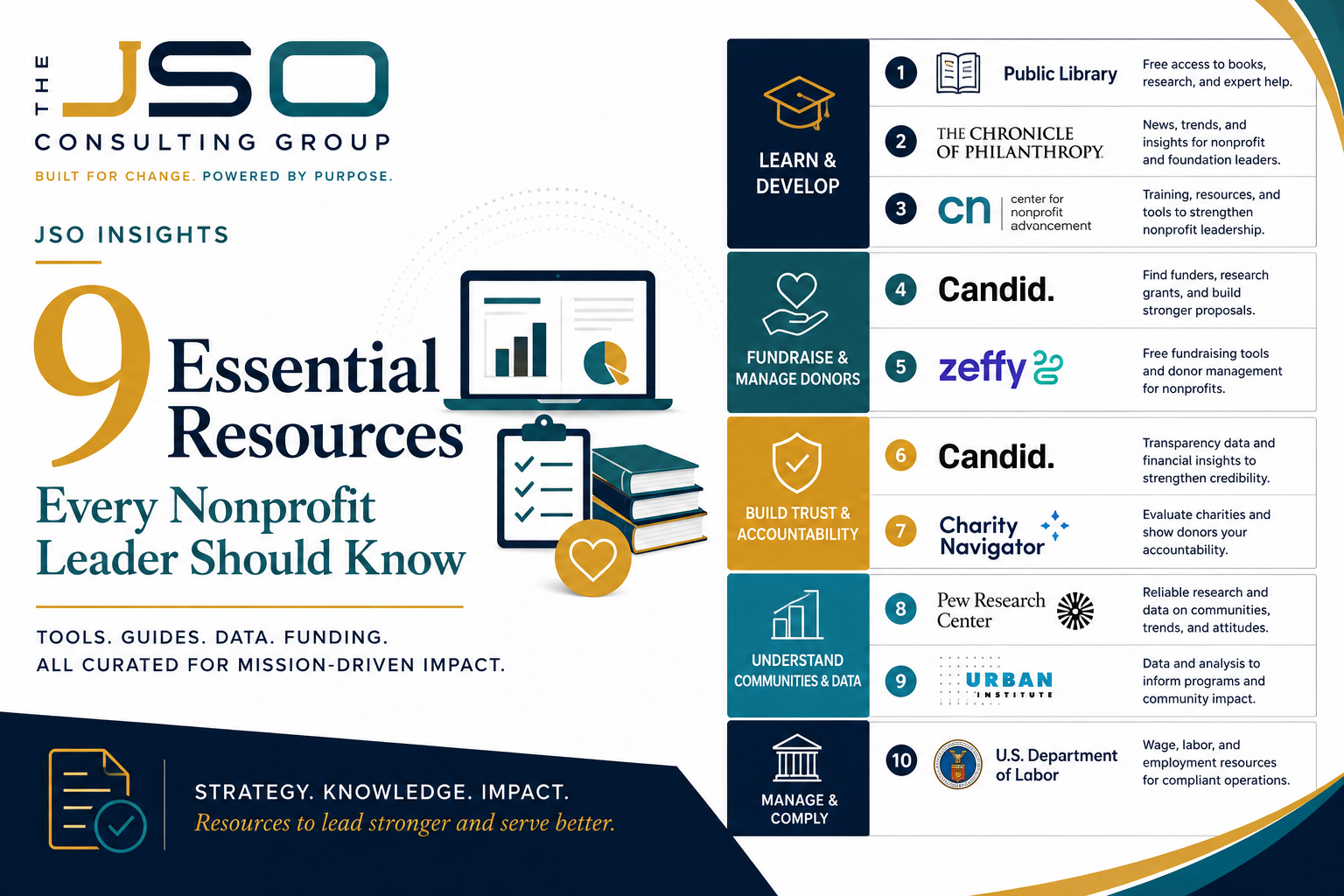
Rather than ranking the tools against one another, use this map to identify which resources can support the challenge in front of you.
Learn & Develop
Fundraise & Manage Donors
Understand Communities
Build Trust & Accountability
Manage & Comply
Start With Your Public Library
Yes, the library.
Before purchasing another research subscription, check what your local public library already gives you access to.
Public libraries increasingly provide digital access to databases, books, journals, newspapers, research reports, professional-development platforms, and other electronic resources.
Some libraries also provide access to specialized business and research databases that can support prospect research, market analysis, and community assessments.
Best for: Research, professional development, databases, e-books, news, and reducing subscription costs.
My advice: Before paying for access to a database or publication, search your library's digital resources first.
The Chronicle of Philanthropy
If you work in nonprofits and philanthropy, you should have some sense of what is happening beyond your own organization.
The Chronicle of Philanthropy is one of the sector's major sources for nonprofit and philanthropic news, analysis, fundraising information, leadership issues, and professional development.
Not every article is free, but even its publicly accessible reporting can help leaders understand changes in philanthropy, fundraising, nonprofit leadership, and public policy.
Best for: Sector trends, fundraising, philanthropy, nonprofit leadership, and staying informed.
My advice: Build sector news into your professional routine. Even 15 minutes a week can make a difference.
Candid
If fundraising or nonprofit research is part of your job, Candid should probably already be bookmarked.
Candid helps nonprofit professionals research organizations, explore funders and grants, review nonprofit profiles, and better understand potential funding relationships. For grant seekers, this can help answer an important question before outreach begins: Does this funder actually align with our organization?
But Candid is not only a tool for researching funders. It is also an important place for nonprofit organizations to establish and manage their own public profile.
Eligible nonprofits can claim their Candid profile and provide information about their mission, programs, leadership, financials, IRS filings, donation opportunities, goals, impact, and other organizational information.
As organizations provide more information, they can earn Candid's Bronze, Silver, Gold, or Platinum Seal of Transparency. These levels give nonprofits a structured way to demonstrate how much information they are making publicly available about their organization, its work, and its impact.
That matters because funders and donors frequently conduct their own research before making grants, awards, sponsorships, or major gifts. Your Candid profile can become part of that due-diligence process.
A Seal of Transparency does not guarantee funding, and it should never replace strong programs, sound governance, or responsible financial stewardship. But an accurate, current, and complete profile can help demonstrate that your organization is willing to be transparent about its operations, finances, programs, leadership, goals, and results.
This makes Candid useful on both sides of fundraising: you can research potential funders while also strengthening the information potential funders can find about you.
Best for: Grant prospecting, funder research, nonprofit profiles, organizational visibility, transparency, fundraising readiness, and funder due diligence.
My advice: Do not only use Candid when you are looking for money. Claim your organization's profile, keep the information current, and work toward the highest appropriate Seal of Transparency.
Zeffy
Zeffy first caught my attention because of its Grant Finder, but the platform offers much more than grant discovery.
Its Grant Finder can help nonprofit professionals identify relevant funding opportunities based on factors such as mission, location, eligibility, funder type, and funding needs. For smaller organizations or development teams with limited prospect-research budgets, that alone can make the platform worth exploring.
But Zeffy also functions as an all-in-one fundraising and donor management platform. Nonprofits can use its built-in CRM tools to organize supporter information, maintain donor records, review giving history, segment contacts, manage communications, support recurring gifts, track fundraising activity, and maintain a clearer picture of donor relationships over time.
That integration can be especially valuable for smaller nonprofits that are otherwise managing donor information across spreadsheets, email accounts, payment processors, event systems, and separate fundraising tools.
Zeffy also stands out because of its pricing model. The platform operates with $0 platform fees and $0 transaction or payment processing fees for nonprofits , allowing organizations to keep the full amount of donations processed through the platform.
For organizations that may not yet have the budget for a traditional nonprofit CRM or fundraising software subscription, that can make fundraising technology far more accessible.
As with any technology platform, nonprofit leaders should still evaluate whether its reporting, integrations, workflows, data management, and features match the needs and complexity of their organization.
And when using the Grant Finder, remember that finding a grant is not the same as being ready for one. Leaders should still evaluate eligibility, funder priorities, geographic focus, deadlines, reporting requirements, previous giving, and strategic alignment before investing time in an application.
Best for: Grant discovery, donor management, nonprofit CRM, online fundraising, recurring giving, campaign management, donor engagement, and reducing fundraising technology costs.
My advice: Do not think of Zeffy only as a place to search for grants. If your organization is paying for several separate tools for donations, donor tracking, communications, and fundraising management, compare those costs and workflows against what an integrated platform can provide.
Center for Nonprofit Advancement
Sometimes the resource you need is not another article. You need training.
The Center for Nonprofit Advancement provides professional development for nonprofit boards, executives, employees, and volunteers across areas such as governance, finance, fundraising, leadership, evaluation, and organizational management.
This can be especially valuable for smaller nonprofits where leaders and staff often manage responsibilities across several functions.
Best for: Board development, executive leadership, capacity building, and practical nonprofit management.
My advice: Do not reserve professional development only for executives. Strong organizations invest throughout the team.
Charity Navigator
Most nonprofit leaders know Charity Navigator as a website donors use to research charities.
That is exactly why nonprofit leaders should be paying attention to it too.
Charity Navigator uses information from the IRS, partner organizations, and nonprofits themselves to help people evaluate charitable organizations. Eligible nonprofits can also manage and update information associated with their profiles rather than leaving their public presence entirely to third-party data.
Its evaluation framework looks across several areas of organizational performance and practice, including Accountability & Finance, Impact & Measurement, Leadership & Planning, and Culture & Compensation.
Depending on the information available for an organization, these areas can contribute to the picture donors and other stakeholders see when deciding whether an organization deserves their trust and support.
For nonprofit leaders, the lesson is larger than simply earning a strong rating. Your Charity Navigator profile is part of your organization's digital due-diligence footprint.
A prospective donor, corporate partner, foundation representative, board candidate, or other stakeholder may research your organization before ever contacting you. If they encounter missing information, outdated information, weak accountability practices, or an incomplete profile, those findings can influence their perception of your organization.
On the other hand, an organization that demonstrates sound financial stewardship, measurable impact, responsible governance, thoughtful leadership, and transparency gives stakeholders more reasons to trust what it says about its work.
Charity Navigator should therefore be viewed not simply as a rating website, but as another place where nonprofit leaders need to understand and manage how their organization is represented publicly.
Best for: Donor confidence, organizational transparency, financial accountability, impact measurement, governance benchmarking, and understanding how your nonprofit appears during external due diligence.
My advice: Search for your own organization on Charity Navigator periodically. Review the profile the same way you would if you were considering making a significant gift.
Pew Research Center
Good programs begin with understanding people.
Pew Research Center conducts public opinion polling, demographic research, and other forms of data-driven social research examining the attitudes, behaviors, and trends shaping society.
Its research can provide valuable context before leaders make assumptions about the populations and communities they hope to serve.
Pew does not replace a local community-needs assessment, but it can help leaders ask better questions.
Best for: Demographic trends, public opinion, social change, technology, civic life, and strategic research.
Urban Institute
For leaders who want to go deeper into data, Urban Institute is another resource worth exploring.
Urban conducts research on social and economic issues affecting people and communities, including housing, education, health, economic mobility, government programs, philanthropy, and nonprofit organizations.
Its research can support needs statements, advocacy, program design, strategic planning, and stronger board-level understanding of the environment in which an organization operates.
Best for: Community data, policy research, nonprofit-sector research, economic conditions, and evidence-based decision-making.
U.S. Department of Labor
Human resources is one of the areas where nonprofit leaders cannot afford to operate on assumptions.
The U.S. Department of Labor provides official information related to wages and hours, workplace safety, employee protections, benefits, labor standards, workforce programs, and employment matters.
Government resources can help leaders understand federal requirements, but they should not replace qualified legal or HR counsel for specific employment situations.
Best for: Employment compliance, wage-and-hour information, workplace standards, workforce data, and HR research.
Leadership lesson: Knowing when to research something yourself and when to call an expert is part of responsible leadership.
Bookmarking nine websites will not make an organization stronger.
Knowing when and how to use them will.
When I am working through a nonprofit issue, I rarely rely on one source of information. I might use Candid to understand a funder's giving history, Zeffy to identify new prospects and manage donor relationships, Urban Institute to examine a community trend, Pew Research Center to understand demographic changes, the Department of Labor to verify an employment requirement, and a library database to locate additional research.
I also think about what those same resources may be telling other people about my organization. A strong research habit is not only about gathering intelligence. It is also about understanding how your nonprofit appears when donors, funders, partners, and other stakeholders conduct their own research.
Each resource answers a different question.
The goal is not to know everything. The goal is to know where to look for credible answers.
There can sometimes be an unhealthy expectation in the nonprofit sector that organizations should simply "do more with less."
That should not be the goal.
Nonprofits need adequate funding. Employees deserve competitive compensation. Organizations should pay for professional expertise when expertise is needed. Leaders should invest in technology, training, research, and infrastructure that strengthen their organizations.
Being resourceful does not mean refusing to spend money.
It means knowing when you need to spend it and when a credible resource already exists.
A multimillion-dollar institution and a grassroots organization operating on a fraction of that budget may have dramatically different capacities, but both can make better decisions when their leaders know how to locate reliable information and continue learning.
Leadership cannot rely only on what worked before.
Our communities change. Technology changes. Funding changes. Laws change. Donor expectations change. The workforce changes. The people and communities we serve change.
Leadership therefore cannot simply be based on what worked five or ten years ago.
These nine resources are a strong place to start. Build them into your professional routine. Share them with your staff. Introduce them during board development. Use them when researching grants, building programs, managing donors, preparing strategy, evaluating performance, strengthening organizational credibility, or challenging assumptions.
In a sector where every resource matters, information itself can be one of the most valuable resources we have.